Should You Stage an Empty Bedroom? How Buyers Read Blank Spaces in Listing Photos
A practical guide to deciding which empty rooms to stage based on buyer perception, room clarity, and listing-photo impact.
· Sophie
Virtual Staging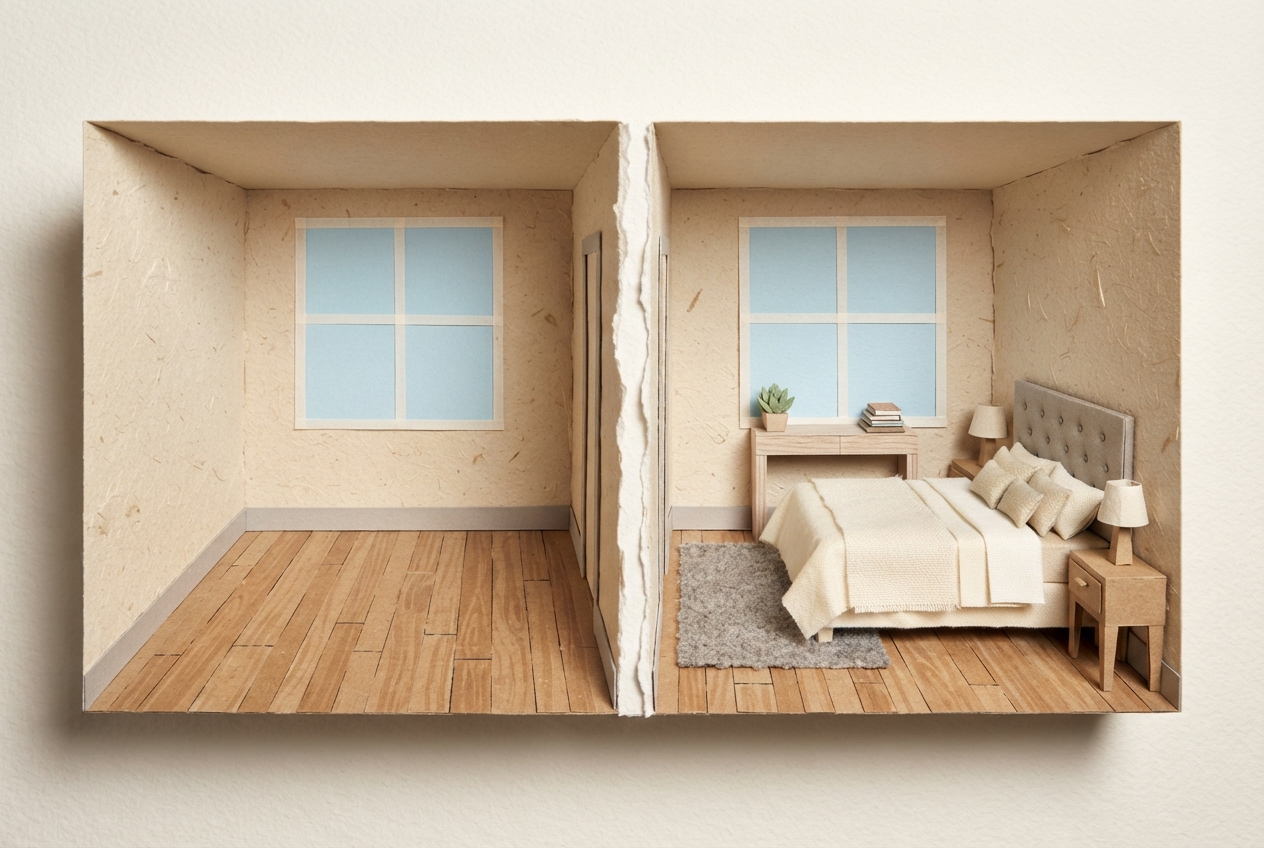
Should You Stage an Empty Bedroom? How Buyers Read Blank Spaces in Listing Photos
A vacant bedroom is not neutral in a listing photo. Buyers often read it as a question mark: Is this room too small for a bed? Is it an awkward office? What would I actually do with it? If you are asking should you stage an empty bedroom, the practical answer is yes when the room's purpose, usable scale, or relationship to the rest of the home is unclear on camera.
Direct answer: Stage an empty bedroom when furniture will help buyers understand how the room functions and what fits inside it. Skip staging when the room is already self-explanatory, photographs well empty, or has a use that is more persuasive without a conventional bedroom setup. The decision is about reducing buyer uncertainty, not decorating every available square foot.
That distinction matters because listing photos are consumed quickly. A buyer scrolling a portal is not standing in the room, pacing off the walls, or opening a measuring app. They are making rapid judgments from a thumbnail and a handful of images. A well-chosen virtual bedroom layout answers the questions an empty room leaves hanging.
Why blank bedrooms create friction in listing photos
An unfurnished bedroom asks the buyer to do mental work. They have to infer dimensions from baseboards, window placement, and the distance between a closet door and a corner. Some will do that. Many will simply register the room as small, strange, or forgettable and move on.
The problem is most acute in secondary bedrooms. A primary bedroom is usually identifiable from its size, ensuite access, or placement in the photo sequence. A smaller room with one window and an empty floor can be interpreted five different ways: nursery, guest room, office, storage room, or a bedroom that barely fits a twin bed. That ambiguity weakens the listing's story.
Staging gives the image a unit of measurement buyers already understand. A twin bed, queen bed, desk, or dresser shows usable clearance more effectively than an unbroken expanse of floor. It also establishes a credible purpose. A buyer with children can picture a child using the space. A remote worker can see an office. A multigenerational household can imagine a guest room.
This is not an argument for filling every room. Oversized furniture or a busy layout can create its own suspicion. Buyers notice when a room seems dressed for the camera rather than designed for a person. The best staged image is believable at a glance: furniture is appropriately scaled, pathways are open, and the layout respects doors, windows, closets, and radiator locations.
Stage the rooms buyers struggle to decode
The most useful question is not, “Which rooms are empty?” It is, “Which rooms need an explanation?” Start with the images likely to cause hesitation.
Small secondary bedrooms
These are often the highest-priority bedrooms to stage. An empty 9-by-10-foot room may look much smaller in a wide-angle photograph, particularly if the camera is positioned near the doorway. A twin bed with a narrow nightstand, or a compact full bed with a simple desk, demonstrates that the room has a workable use without pretending it is larger than it is.
Match the layout to the property and the likely buyer. In a three-bedroom starter home near schools, a child’s room reads naturally. In a downtown condo, a flexible guest room with a desk may better reflect how buyers expect to live. The goal is not to dictate one lifestyle. It is to make the room legible.
The room that could be a bedroom or an office
A flex room is valuable only when buyers can see its flexibility. If the listing count depends on it being understood as a legal bedroom, lead with a bedroom arrangement that accurately reflects its dimensions and features. If it is clearly marketed as a den, loft, or bonus room, an office setup may be more honest and more useful.
Do not use virtual staging to blur an architectural fact. A room without a closet, egress, or other locally required feature should not be presented in a way that misrepresents its status. Staging can clarify a use. It cannot change a room's legal classification.
Awkward layouts and narrow rooms
A long, narrow bedroom can look like a hallway. A room with a sloped ceiling, offset window, or door swing can make buyers assume furniture will not fit. These rooms benefit from staging that solves the layout visually. Put the bed where a person would realistically place it, preserve walking space, and use only the pieces necessary to explain the plan.
Here, accuracy matters more than style. BetterSpace_2's automatic staging is useful for rooms like these because it is designed to place furnishings in layouts that follow the photographed room's proportions and perspective. The result should show what the room can accommodate, not invent a more convenient version of the room.
The oversized primary bedroom
An unusually large primary can also need help. Empty, it may read as cold or vaguely hotel-like, with no clear sense of where sleeping, reading, or dressing zones belong. A correctly scaled bed and restrained seating area give the space rhythm. Buyers can understand that the extra square footage is usable rather than merely empty.
When you should leave a bedroom empty
Staging is not automatically the best move. There are situations where an empty photograph gives the buyer clearer information.
Leave the room vacant when it is newly renovated and the selling point is the finish work: restored floors, detailed millwork, a distinctive window wall, or an unusually large footprint that is obvious without furniture. A clean, bright room with clear dimensions can stand on its own.
Also consider leaving a room empty when the property is likely to be purchased for renovation or redevelopment. In that context, a staged guest bedroom may distract from what the buyer is actually evaluating: structural condition, lot, location, and renovation potential.
Finally, do not stage a room if the available image is too compromised to support a credible result. Severe distortion, poorly exposed corners, blocked architectural features, or a viewpoint that does not show the room's boundaries can make any staging look less trustworthy. Retake the photo first if possible. Better input produces a more believable virtual result.
Which rooms to virtually stage first in a vacant listing
If you have a limited number of images to improve, prioritize the rooms where the buyer has the most to gain from visual context:
- The primary bedroom, if it is large, oddly shaped, or lacks an obvious furniture wall.
- The smallest bedroom, because buyers are most likely to question fit and function there.
- A flex room or loft, where staging can establish a realistic everyday use.
- The main living room, especially in an open plan where it defines circulation and scale.
- The dining area, if buyers may not recognize where a table belongs.
Bathrooms sit in a different category. If you are wondering whether staging a bathroom helps sell a house, it can help an otherwise sterile bath feel maintained and usable, but it rarely changes a buyer's understanding of the floor plan. A few restrained accessories, fresh towels, or a small plant can soften an image. Avoid elaborate bathroom staging that obscures tile, vanity storage, shower size, or condition. Buyers want to inspect those details.
A kitchen usually needs even less virtual intervention. Its function is immediately obvious, and buyers are assessing cabinetry, counters, appliances, and layout. An empty bedroom, by contrast, is often a blank canvas in the least helpful sense: it supplies space but no interpretation.
How a staged bedroom should read in photos and video
The standard is simple: a buyer should believe the furniture could have been there when the photographer arrived. That requires more than dropping a bed into an image.
Start with the camera angle. Furniture needs to sit on the correct plane of the floor, with perspective lines that follow the room. A bed should not appear to float, block an opening, or look wider than the wall behind it. Lighting must also match the source image. If sunlight enters from the left, shadows and highlights should make sense from that direction.
Then edit for the listing, not for a design feed. Use a limited palette, ordinary proportions, and a layout that gives the buyer a clear reading in one second. A queen bed, two narrow nightstands, and a rug may be enough. Adding benches, oversized lamps, stacks of books, and decorative furniture can obscure the evidence buyers are looking for.
This is where automatic staging tools should be judged carefully. BetterSpace_2 is built to create realistic room staging and listing content while retaining the room's existing architecture, perspective, and layout. That matters because the common failure mode in AI-generated real estate images is not a slightly imperfect throw pillow. It is an altered window, a missing door, fabricated built-in storage, or lighting that makes the room feel physically impossible.
For video, consistency matters across frames and adjacent images. If a room is shown as a bedroom in the photo set, its role should not change without explanation in a listing video. Buyers build a mental map as they watch. Consistent staging supports that map; conflicting staging interrupts it.
A practical review before publishing staged listing photos
Before uploading, compare every staged version with the original photograph side by side. Look for four things: preserved architecture, believable scale, clear room purpose, and an image that does not hide material property details.
Check local MLS rules, brokerage policy, and applicable advertising requirements as well. Many markets require virtual staging to be disclosed, and disclosure is good practice even when the rule is unclear. A concise note such as “Virtually staged to show potential” protects the buyer's understanding without making the image less useful.
The cost question is usually straightforward. Virtual staging is generally easier to deploy than physical staging across multiple vacant rooms, and platforms such as BetterSpace_2 offer a free plan with one video per month, with paid plans starting at $29 per month. But room selection should come before the tool choice. The strongest image is the one that answers a real buyer question.
Make blank space easier to believe in
An empty bedroom does not need furniture because buyers lack imagination. It needs staging when the photo asks them to imagine too much, too quickly. Use it to show fit, function, and flow, especially in smaller bedrooms, ambiguous flex spaces, and rooms with awkward geometry.
When the architecture already tells the story, let it breathe. When the room creates doubt, stage it with restraint and accuracy. Buyers do not need a fantasy version of the property. They need a convincing picture of how they could live in the space.